
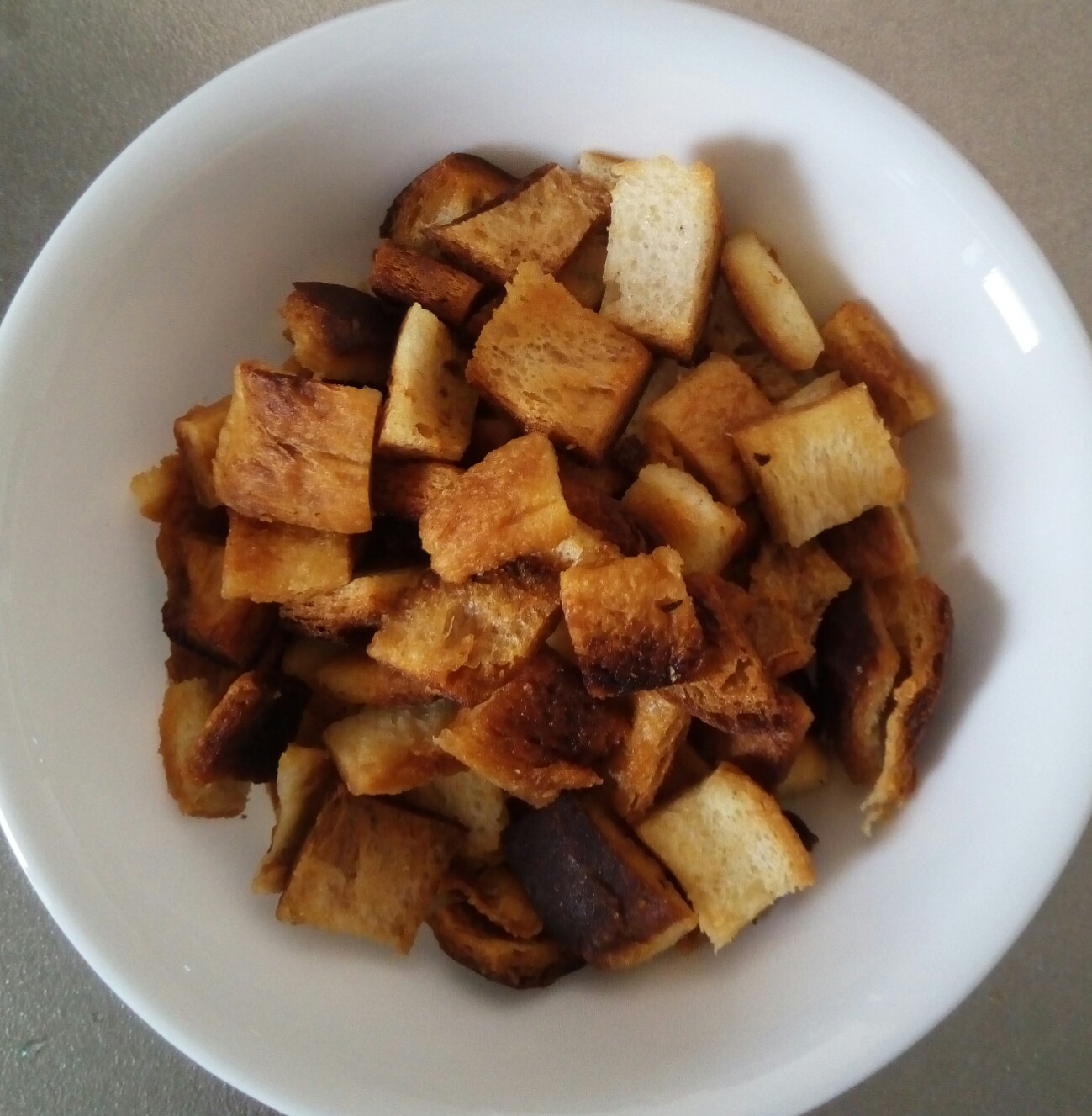
Bread crusts are often overlooked, but with a bit of butter and honey, they transform into a delightful snack. In this experiment, I prepared “Honey Bread Crust Rusks” using a frying pan.
However, the results led to an interesting observation regarding texture and moisture removal. Is a frying pan truly the best tool for a “crispy” finish? Let’s analyze the process.
CONTENTS
Honey Bread Crust Rusk (Ingredients)
This is a high-efficiency recipe that turns leftovers into a satisfying 531kcal treat.
| # | Ingredients | Grams (g) | Calories (kcal) | Price (yen) |
| 1 | Bread (crusts) | 130 | 341 | ¥102 |
| 2 | Butter | 20 | 146 | ¥44 |
| 3 | Honey | 15 | 44 | ¥18 |
| – | (Total) | 165g | 531kcal | ¥164 |
Calories and prices are approximate values.
Honey Bread Crust Rusk (Instructions)
・First, I trimmed the bread crusts and cut them into pieces about 2 cm long.

・Next, I melted butter in a frying pan. Then, I added the bread crusts.

・I stir-fried them over low heat for 5 minutes, then turned off the heat, added honey, and mixed it in.

・ After that, I stir-fried them for another 3 minutes over low heat. The result wasn’t as crispy as when I use a microwave. It seems a frying pan doesn’t evaporate the moisture as effectively.

🧪 The Evaporation Challenge
1. Texture Analysis
While the flavor was excellent—rich with butter and the floral sweetness of honey—the texture was less “crispy” than I expected. Compared to my previous experience using a microwave, these pan-fried rusks felt slightly softer.
2. Frying Pan vs. Microwave (Physics of Drying)
The difference in crispiness comes down to how moisture is evaporated:
-
The Microwave Method: Microwaves excite water molecules throughout the bread, forcing moisture out from the inside out very rapidly. This leads to a dry, porous, and highly crispy structure.
-
The Frying Pan Method: Heat is applied only to the surface (conduction). While it creates a beautiful golden-brown exterior via the Maillard reaction, it is less effective at “drawing out” the internal moisture of the bread crusts. The honey added later also acts as a humectant, trapping some of the remaining water.
3. Engineering a Better Crunch
To achieve a “microwave-level” crunch using a frying pan in the future, I plan to:
-
Pre-dry the bread: Air-dry the crusts for a few hours before cooking to reduce initial moisture.
-
Extended Low-Heat Toasting: Increase the initial stir-frying time at an even lower temperature to allow internal moisture to escape before adding the moisture-locking honey.

コメント